
Cuidar el cuello hoy es invertir en bienestar para el futuro
June 10, 2026
Private Label Menstrual Cramp Warmer Patch: Buyer Guide for Wellness Brands
July 10, 2026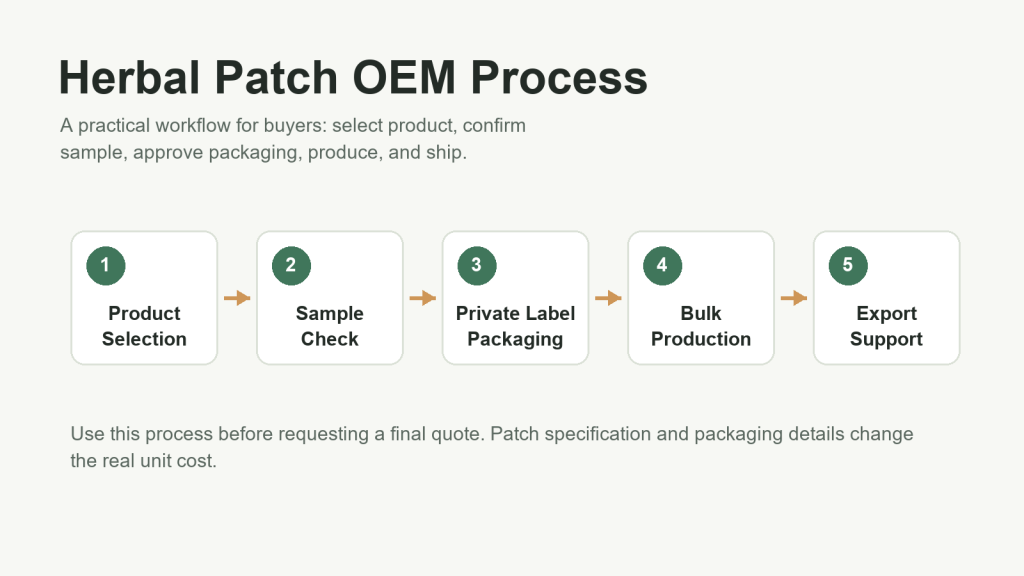
Quick Answer
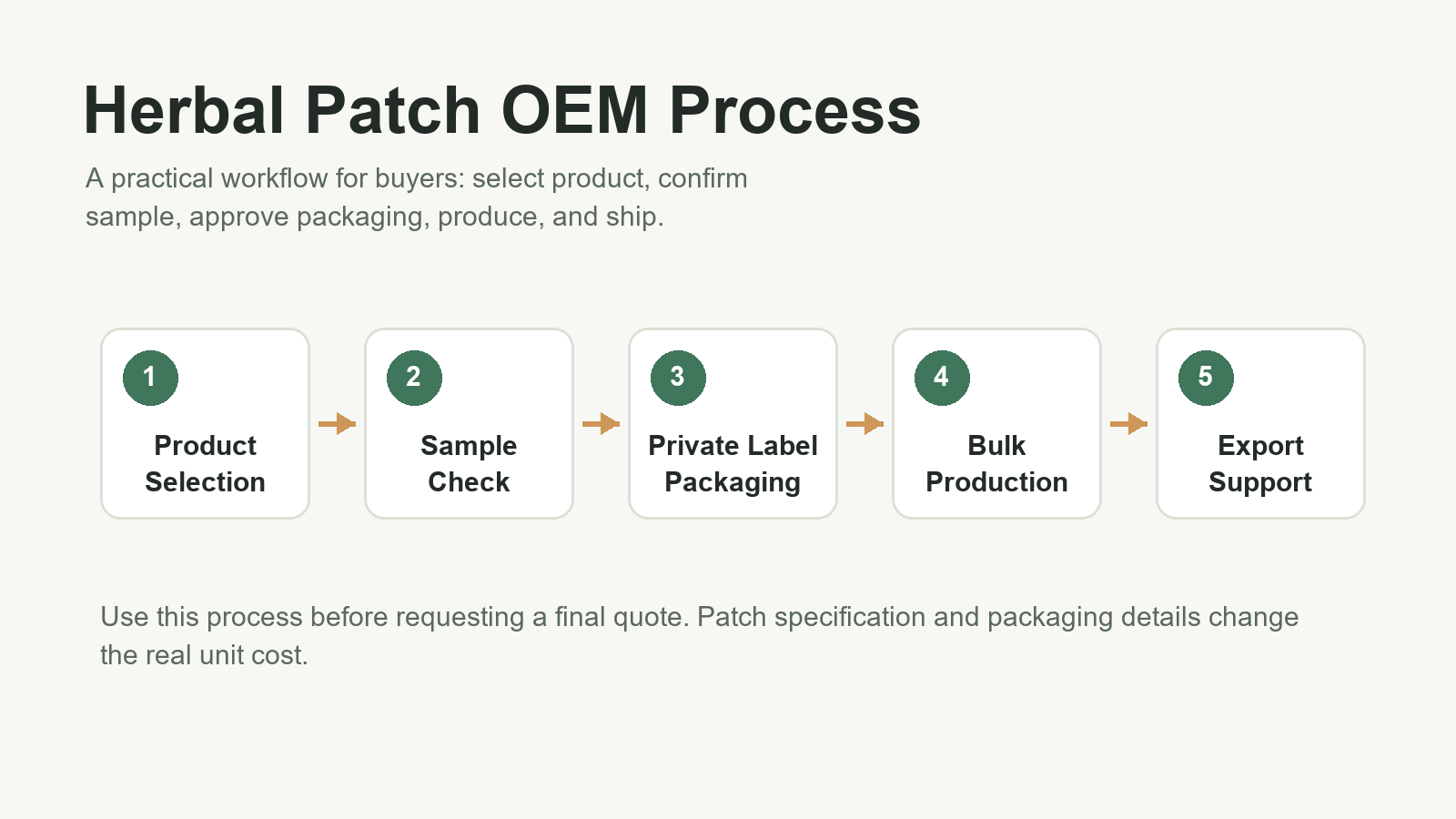
A herbal patch OEM project usually starts with product selection, then moves to samples, packaging design, label confirmation, bulk production, and export preparation. Buyers should confirm patch type, size, adhesive comfort, packaging count, label language, MOQ, and target market before asking for a final price. A useful quote must include product details and packaging details, not only a unit price.
This guide is written for importers, wellness brands, pharmacies, distributors, Amazon sellers, TikTok Shop sellers, and private label buyers who want to build a herbal patch product line.
What Herbal Patch OEM Means
Herbal patch OEM means the supplier manufactures herbal patches according to your brand and market requirements. The product may use an existing patch type, while the packaging, label language, box design, and product positioning are adapted for your brand.
Common OEM products include:
- Herbal extract plaster
- Cervical care patch
- Acupoint magnetic therapy patch
- Far infrared magnetic therapy patch
- Menstrual cramp warmer patch
- Warming herbal patch
For most new buyers, OEM does not mean developing a completely new formula from zero. It usually means choosing a proven product type, confirming the patch specification, and creating a private label package that fits your sales channel.
Step 1: Choose the Product Direction
Before asking for price, decide what type of buyer you want to serve.
| Target market | Better product direction |
|---|---|
| General wellness stores | Herbal extract plaster |
| Office worker and driver market | Cervical care patch |
| Women's wellness products | Menstrual cramp warmer patch |
| Pharmacy and distributor channels | Acupoint or far infrared magnetic therapy patch |
| Online starter brand | One focused hero product with simple packaging |
If your market is still untested, do not start with too many SKUs. Choose one hero product and one backup product. This makes it easier to test customer feedback and manage inventory.
Step 2: Confirm Patch Specification
The patch itself affects cost, customer experience, and packaging design.
Buyers should confirm:
- Patch type
- Patch size
- Patch shape
- Heating or non-heating design
- Magnetic or non-magnetic design
- Far infrared feature or standard herbal positioning
- Adhesive comfort
- Skin-contact material
- Single-use pouch format
- Shelf-life and storage requirements
Do not compare two supplier prices unless the specifications are clear. A lower price may come from a smaller patch, simpler pouch, lower box count, or different material.
Step 3: Choose Packaging Format
Packaging is where many private label projects succeed or fail. For herbal patches, the package must explain the product clearly without making risky medical promises.
Common packaging options:
| Format | Best for |
|---|---|
| Single pouch | Sample, travel use, wholesale replenishment |
| Retail box | Pharmacy, wellness stores, e-commerce |
| Multi-count box | Better perceived value and repeat use |
| Display box | Offline retail counter sales |
| Neutral package | Small test order or distributor trial |
For private label projects, the package should usually include brand name, product name, count per box, usage direction, storage information, importer information, barcode area, and market-required label language.
Step 4: Keep Claims Language Safe
Herbal patch content should be written carefully. Many buyers want strong claims, but aggressive medical wording can create compliance risk.
Safer wording examples:
| Risky wording | Safer B2B wording |
|---|---|
| Cures neck pain | Supports daily neck and shoulder comfort |
| Treats dysmenorrhea | Provides warming care during menstrual discomfort |
| Eliminates inflammation | Designed for soothing daily body care |
| Medical therapy patch | Wellness patch / herbal care patch |
| Guaranteed effect | Designed for comfort support |
Your final packaging language should be checked against the rules of your target market. Different countries may treat herbal patches, warming patches, and topical products differently.
Step 5: Request Samples Before Bulk Order
Samples help buyers check:
- Patch size and feel
- Adhesive strength
- Pouch opening experience
- Heat feel if it is a warming product
- Packaging direction
- Product smell and comfort
- Whether the product matches the sales channel
For private label orders, it is better to approve the sample and packaging layout before bulk production. This reduces misunderstandings and protects both sides.
Step 6: Confirm MOQ and Lead Time
MOQ depends on product type, packaging complexity, and customization level.
Typical factors that affect MOQ:
- Whether the product is standard or customized
- Whether private label box printing is required
- Whether custom pouch printing is required
- Number of SKUs
- Label language
- Carton mark requirements
- Seasonal production schedule
Lead time also changes based on packaging approval speed. Many delays happen because label text, logo files, or box dimensions are not confirmed early.
Step 7: Prepare Export Details
Before shipment, buyers should confirm:
- Product name for invoice and packing list
- Carton quantity and carton size
- Gross weight and net weight
- Shipping mark
- Destination port or address
- Required documents
- Importer label details if needed
For first orders, keep the product range focused. A clean first shipment is more valuable than a complicated order with too many untested SKUs.
Common Mistakes in Herbal Patch OEM Orders
Mistake 1: Asking only for the lowest price
Price is important, but a unit price without size, packaging, and MOQ details is not useful. Ask for a comparable quote based on the same specification.
Mistake 2: Using medical claims too early
Strong claims may look attractive, but they can create listing, customs, advertising, or platform problems. Keep wording practical and market-safe.
Mistake 3: Launching too many products at once
New buyers often want a full product line immediately. A better first order is two or three products with clear positioning.
Mistake 4: Ignoring packaging until the end
Packaging affects MOQ, lead time, cost, and market acceptance. Discuss it at the beginning.
Mistake 5: Not checking the target sales channel
A package for pharmacy shelves is different from a package for online video sales. Your sales channel should guide the design.
Buyer Checklist
Before contacting a herbal patch OEM supplier, prepare:
- Target country
- Sales channel
- Product type
- Expected retail price
- Preferred packaging format
- Brand logo if available
- Label language
- Expected order quantity
- Need for samples
- Import document requirements
With these details, the supplier can recommend a more practical product plan and give a more accurate quote.
FAQ
What is the best first product for a herbal patch private label brand?
For a general wellness brand, a herbal extract plaster or cervical care patch is usually easier to explain. For a women's wellness brand, a menstrual cramp warmer patch may be a stronger starting SKU.
Can I use my own brand name on the package?
Yes. Private label packaging can include your brand name, logo, product name, box design, label language, barcode area, and importer information.
How many SKUs should I launch first?
For a new market, two or three SKUs are enough. This makes testing easier and reduces inventory pressure.
Can the supplier help with packaging wording?
Yes. A practical supplier can help prepare B2B-safe product wording, but the final label should still be checked according to your local market requirements.
Where can I see related herbal patch products?
See the main supplier page: Herbal Patch Manufacturer.
